Tender
AI-Powered Relationship Wellness App
Overview
Tender is an AI-powered relationship wellness app built from scratch in 48 hours during a hackathon. Grounded in Gottman's research on the 5:1 positive-to-negative interaction ratio, the app helps couples log everyday moments, detect recurring patterns, and receive therapy-informed coaching — all through a warm, plant-based growth metaphor. The tagline: "Nurture what matters, one moment at a time."
What makes this project unique is the process: I used AI (Claude) as a copilot at every stage — from analysing survey data and prioritising features, to designing the suggestion engine, generating a PRD for Lovable, crafting the landing page, and preparing the demo script. This case study showcases the prompts I used and the decisions they informed.
User Research & Segmentation
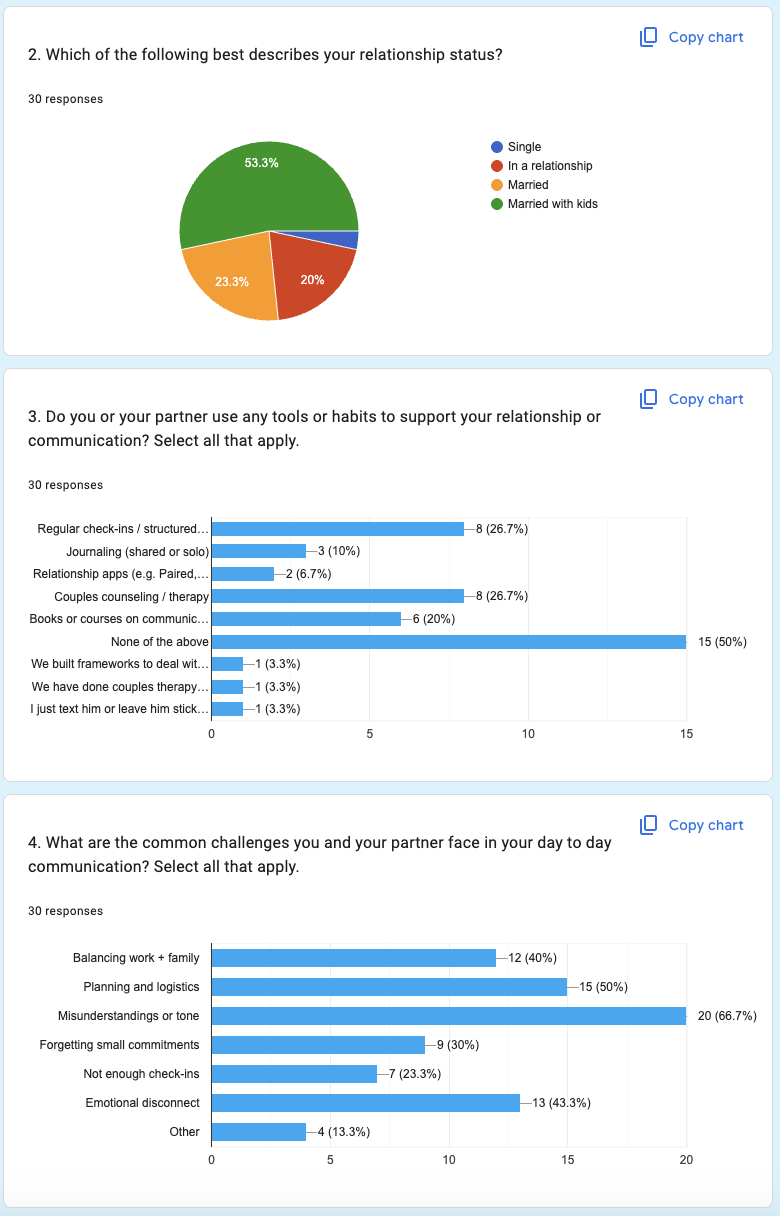
I surveyed 27 couples to understand relationship communication habits, pain points, and feature preferences. Respondents were segmented by helpfulness score, age, relationship status, and willingness to engage daily. The top challenges were misunderstandings or tone (67%), planning and logistics (50%), and emotional disconnect (43%). Notably, 50% of respondents had no tools or habits to support their relationship.
Three distinct personas emerged: Therapy-Augmenters, Proactive Self-Improvers, and First-Time Seekers. I prioritised Maya (32, therapy-augmenter, 2 kids) as the primary persona — she had the highest must-have feature count, clearest pain points, and strongest retention motivation.
Prompt "Analyze survey results and identify top 3 personas based on users who rated the app most helpful (4-5 score). Prioritize based on pain point severity, feature demand, and willingness to engage daily."
Feature Prioritisation
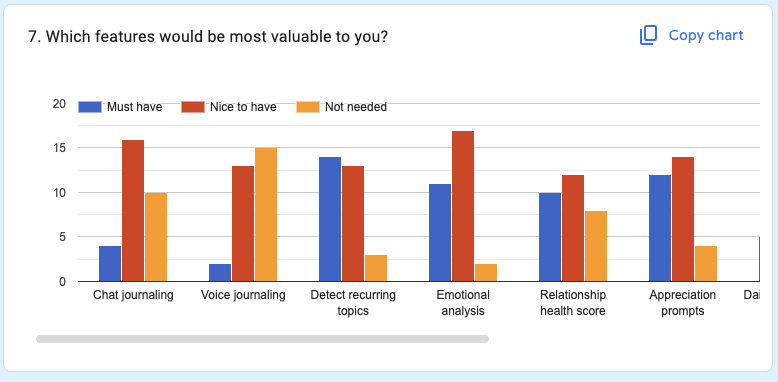
I generated a full feature backlog and prioritised against high frequency pain point × high severity × low effort, filtered specifically for busy parents (Maya & Alex profile). I then pushed further into AI-first feature thinking to differentiate from generic relationship apps like Paired and Lasting.
Must-haves: Link Partners, Quick Emotion Check-In, Detect Recurring Topics, Private vs Shared Mode, and Conflict Resolution Tips. Nice-to-haves included Voice Memo Logging, Rephrase My Message, Conversation Prep Assistant, and Personalised Date Ideas.
Prompt "Based on survey inputs on must-haves and nice-to-haves, prioritize top 10 features for Maya and Alex, a busy couple with kids." "Suggest more actionable AI-first features, e.g. rephrase a conflict discussion."
Core Product & AI Suggestion Engine
The core product logic is built around Gottman's 5:1 ratio. Couples log moments as either "Nurtured" (Appreciated, Connected, Joyful, Supported) or "Needs Care" (Hurt, Frustrated, Distant, Unheard). The ratio maps to four plant-based growth stages: Needs Tending → Seedling → Sprouting → Blooming. All moments — private and shared — count toward the health score, but no numeric balance is shown; only the plant stage is visible.
I designed a 4-tier AI suggestion system that moves from generic advice to contextual, Gottman-informed coaching: Crisis → Pattern-Specific → Emotion-Specific → Ratio-Based. Each emotion maps to a specific communication tool (Hurt → repair script, Unheard → active listening, Distant → connection bid).
Prompts "How should I handle private vs shared entries — if private, should it impact health score?"
"Review suggestion generator logic and suggest how to improve it, especially incorporating couples communication tools when a user logs a needs care moment."

Moments & Pattern Detection
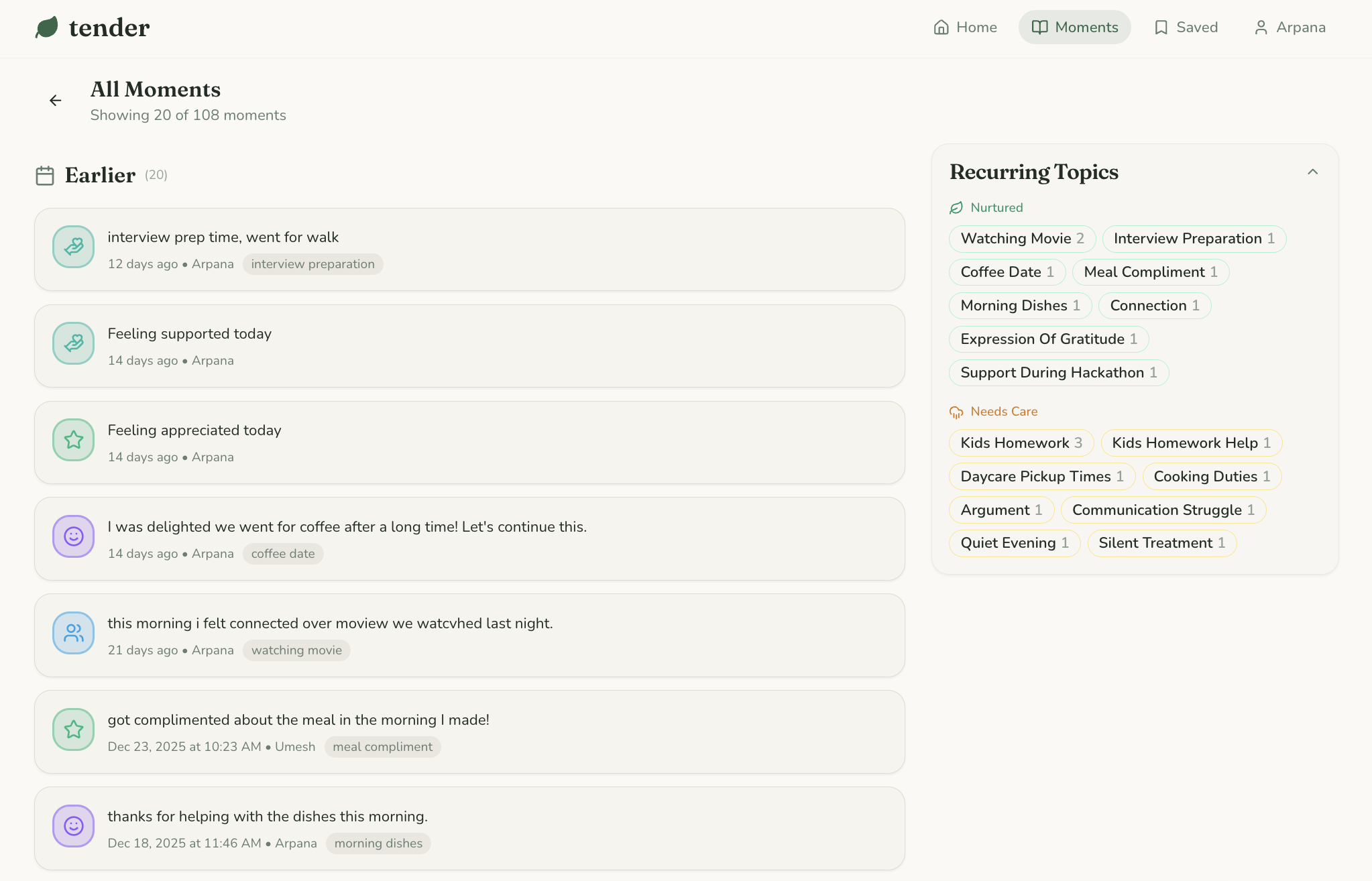
Users log moments in 60 seconds with emotion tagging and a gentle note. The AI detects recurring topics across both Nurtured categories (Watching Movie, Coffee Date, Expression of Gratitude) and Needs Care categories (Kids Homework, Communication Struggle, Silent Treatment) — surfacing patterns that couples may not notice on their own. This transforms individual moments into an evolving map of relationship dynamics.
Landing Page
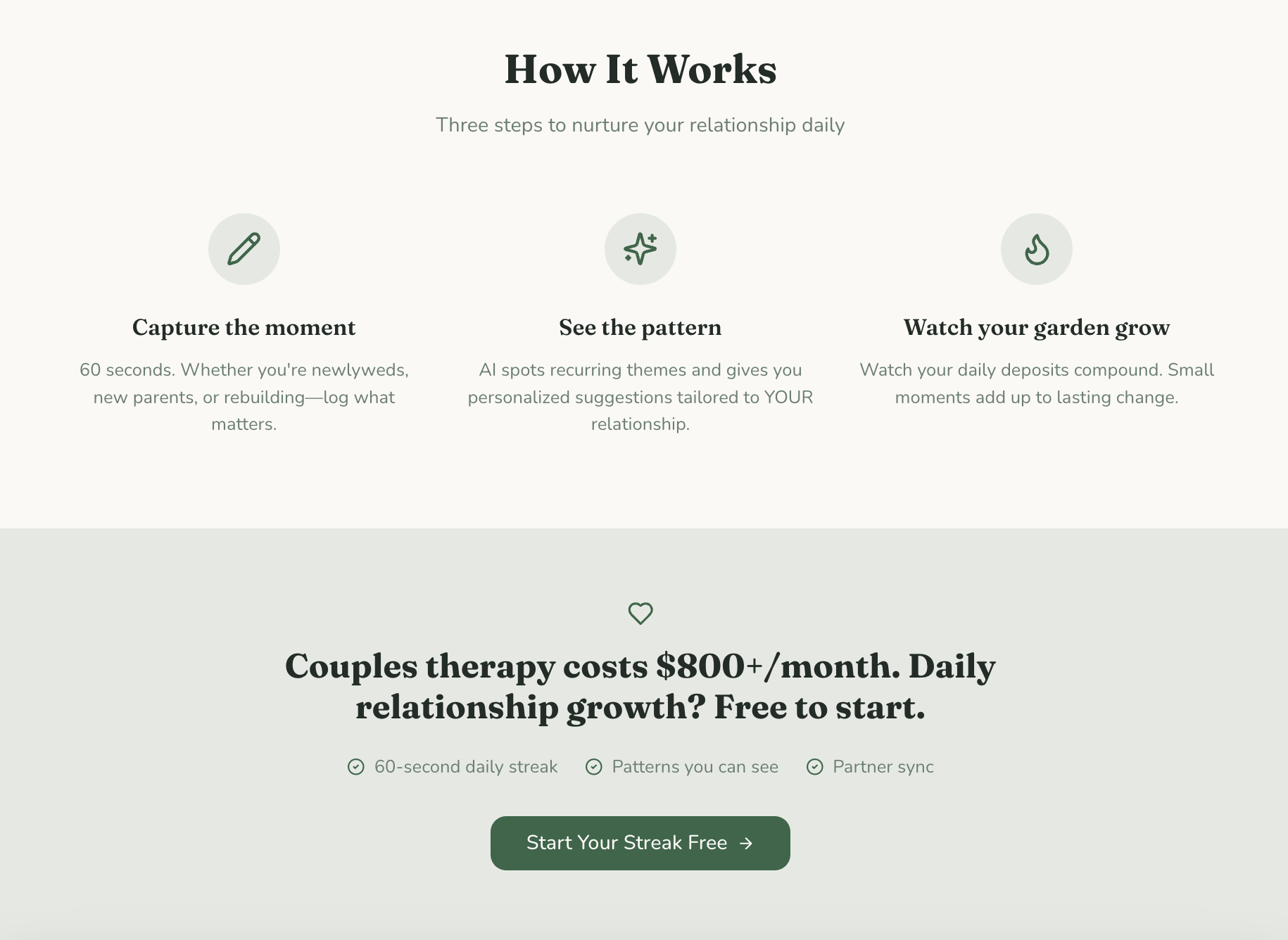
I structured the landing page around the therapy-augmenter persona, leading with emotional resonance before introducing features. The hero copy — "Therapy gave you the tools. Life got in the way." — speaks directly to couples who have invested in counselling but struggle to maintain progress in daily life. The page follows a Problem → Solution → How It Works → CTA flow, with section prioritisation mapped to hackathon time constraints.
Prompt "Help create a landing page for the Tender app." "Suggest 5 tagline options — see attached screenshot of current UI."
Tech Stack
The app was built on a modern React + Supabase stack, with AI powered entirely through the Lovable AI Gateway — requiring no external API keys. The architecture cleanly separates frontend (React/Vite), backend (Supabase with PostgreSQL and Edge Functions), and AI (Gemini models via structured tool calling).
AI Edge Functions
| Function | Model | Purpose |
|---|---|---|
extract-moment |
Gemini 2.5 Flash | Extracts topics and insights from journal entries using structured tool calling |
generate-relationship-suggestion |
Gemini 2.5 Flash | Generates personalised relationship suggestions based on Gottman Method principles and sentiment analysis |
generate-mood-prompt |
Gemini 2.5 Flash Lite | Creates empathetic placeholder prompts based on selected mood |
reprocess-moments |
Gemini 2.5 Flash Lite | Batch re-extracts topics from existing moments with retry and backoff |
AI Patterns
- Function/tool calling — Structured JSON extraction, not free-text parsing
- Feedback loop — User thumbs up/down on suggestions feeds back into future AI prompts
- Rate limit handling — Exponential backoff with retries (up to 5 attempts)
- Sentiment-aware routing — Negative moments trigger repair suggestions; positive moments trigger growth suggestions
Stack Summary
- Frontend: React 18, TypeScript, Vite, Tailwind CSS, Radix UI/shadcn, Framer Motion
- Backend: PostgreSQL with Row Level Security, Supabase Auth, Supabase Realtime, Edge Functions (Deno)
- Hosting: Lovable Cloud at
usetender.lovable.app
Prompt Patterns That Worked
Across the 48-hour build, seven distinct prompting patterns proved most effective for driving product decisions with AI:
- Segment before solve — Analyse first, prioritise second, brainstorm third
- Constraint-first design — Given 48 hours and this persona, what matters most?
- Role-framing — "Answer as if responding to Lovable's technical questions"
- Comparative evaluation — "Is X better than Y for this specific reason?"
- Brief + honest — "Keep to one para, be direct, don't appease me"
- Iterative refinement — "Update with above edits, re-review for human voice"
- Data-grounded decisions — "Use survey results to justify persona prioritization"